What Cortisol Actually Does in Perimenopause

I used to think my worth came from how much I could handle. For a long time, I truly believed being a good wife, mom, daughter, employee, and woman meant keeping up with everything all the time. I thought I should be able to carry it all without needing help, and for years, I did exactly that.
In my late 30’s and early 40’s, I was managing a large team at work while also raising two kids with my husband and trying to keep life moving at home. Most days felt like a constant cycle of responsibilities. I would work long hours, pick up the kids, drive 40 minutes home, make dinner, clean up the kitchen, help get everyone settled for the night, and then finally sit down completely exhausted. My husband absolutely helped, especially with the kids and bedtime routines, and we worked together as a team in many ways, but I still carried a lot of the mental load that so many women quietly hold onto.
Even in supportive homes, women are often the ones mentally managing everything. We remember the schedules, plan the meals, think ahead, organize the details, and carry the constant awareness of what still needs to be done. At the time, I didn’t even recognize that as stress because it felt so normal to me. I thought this was simply what women were supposed to do. I mean, that's what my mom did!
Eventually though, my body started changing in ways I couldn’t ignore anymore.

At first it was subtle. I noticed I had less energy than I used to. My workouts became harder...or maybe I was just getting weaker. I felt emotionally numb a lot of the time, which looking back now was probably one of the biggest signs that my nervous system was completely overwhelmed. By the end of the day, my brain felt like it could not process one more decision. I actually remember wondering at one point if what I was experiencing was severe decision fatigue or something much worse because the brain fog became so intense.
Mornings felt especially hard. I would wake up exhausted and frustrated with myself for staying up too late the night before or for drinking wine again even though I already felt depleted. Looking back now, I can see that my nervous system never truly relaxed. I was constantly moving from one responsibility to the next without ever really slowing down long enough for my body to recover.
At the time, I thought I just needed to push harder. I thought something was wrong with me because I couldn’t handle life the same way I used to. What I understand now is that my body wasn’t failing me. It was responding to chronic stress, and one of the biggest players in that stress response is cortisol.
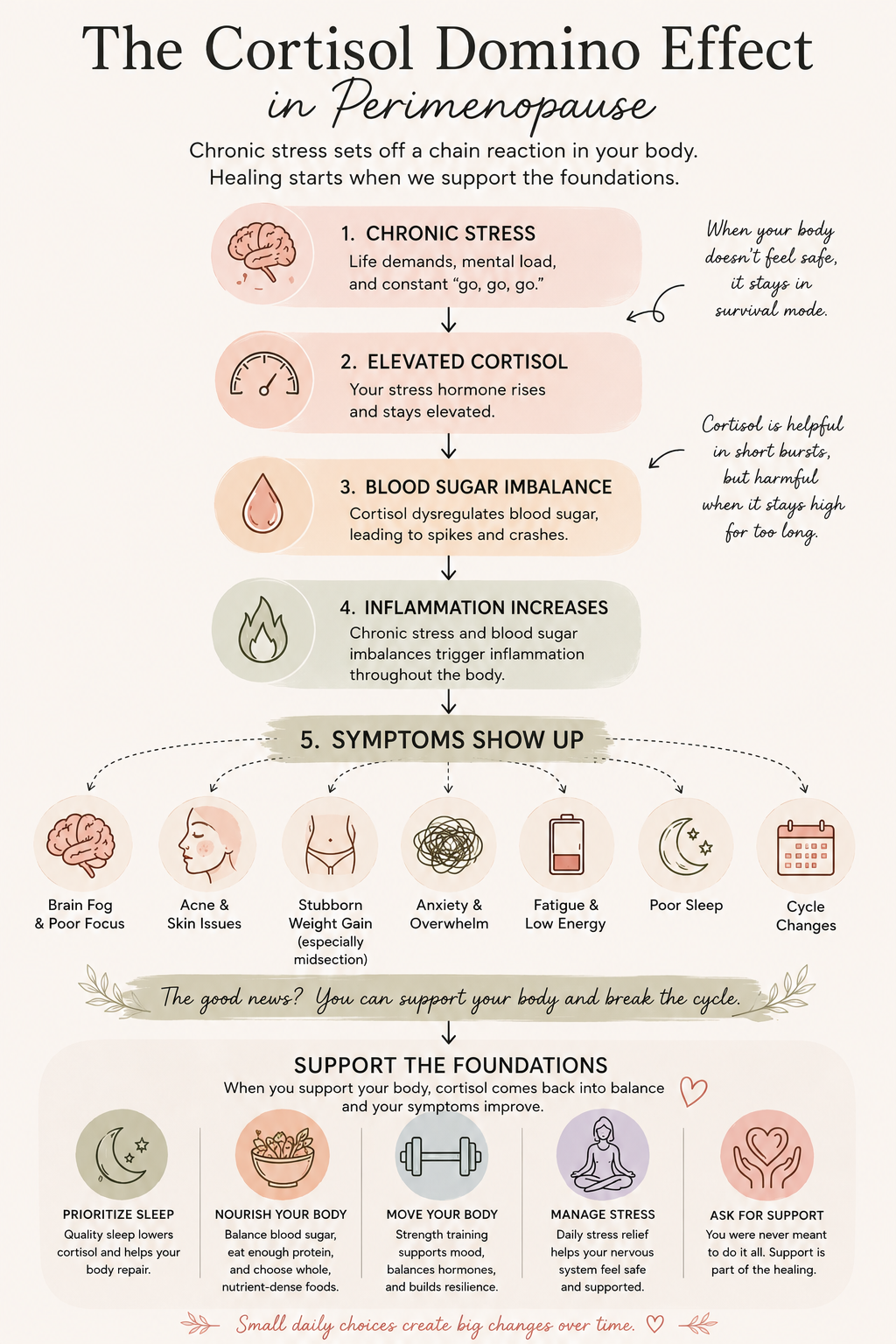
What Cortisol Actually Does
This is actually one of the two foundational hormones I talk about here
Cortisol is often called the stress hormone, but it actually plays a very important role in the body. We need cortisol! It helps regulate energy, blood sugar, inflammation, metabolism, immune function, and even our sleep-wake cycle. Healthy cortisol levels help us wake up in the morning feeling alert and able to handle daily life.
The issue isn't cortisol itself. The issue is that many women are living in a constant state of stress without enough recovery, nourishment, or support, and over time the body starts responding accordingly.
During perimenopause, this becomes even more important because our bodies become more sensitive to stress as our hormones begin shifting. At the same time, many women are juggling careers, kids, relationships, aging parents, financial pressure, poor sleep, overstimulation, inflammation, and nonstop mental responsibility. Even some of the "healthy" habits women are trying to do can add more stress to the body, especially things like over-exercising, under-eating, skipping meals, over-consuming caffeine, or constantly trying to push through exhaustion.
Our bodies were never designed to stay in survival mode all the time.
Over time, elevated cortisol and chronic stress can contribute to symptoms like brain fog, anxiety, inflammation, stubborn weight gain around the midsection, sleep issues, cravings, irritability, exhaustion, acne, and cycle changes. One of the biggest things I’ve learned through this process is that the body is always communicating with us.

How to Start Supporting Your Cortisol
Now when I’m especially stressed, I notice it much faster. My skin changes, my inflammation increases, or my cycle shifts, and instead of ignoring those signs, I’m learning to see them as information. My body is letting me know it needs support.
That shift in perspective has changed so much for me because supporting cortisol and the nervous system doesn’t have to mean doing anything extreme. In many ways, healing has looked much simpler than I expected. It has looked like slowing down intentionally, asking for help, letting go of perfectionism, prioritizing sleep, balancing blood sugar, eating enough protein, strength training in a supportive way, and creating moments of actual rest without guilt.
I think one of the biggest mindset shifts for me has been realizing that women were never meant to carry everything alone. We have normalized stress and overwhelm to the point where exhaustion feels like a personality trait instead of a signal that something needs support.
If there is one thing I hope women take away from this conversation, it’s that you are not failing because you feel exhausted. You are not weak because you need rest, and you are definitely not alone if you feel overwhelmed trying to keep up with everything.
Our bodies want safety, and when we start doing the things that make us feel safe (or removing some of the things that don't), we can begin to heal.
If you are feeling overwhelmed, or if you have entered that perimenopause window, I hope this helps you feel a little more understood and a little less alone. And I can’t wait to continue sharing more of these foundational conversations with you.