The Hidden Stressors Affecting Your Hormones Every Day

If I asked you what stress is, how would you answer?
Would you say it's a work deadline, family problems, financial pressure, or a major life event?
When I first started learning about hormones and stress, that's what I thought stress was too. I didn't realize it went much deeper than that, especially during perimenopause, when the body is already working hard to adapt to shifting hormones. I had no idea how many things actually create stress in the body.
My own journey down this path started after dealing with mold exposure. I began researching inflammation and trying to understand why my body felt the way it did. I was experiencing anxiety, asthma, acne, fatigue, brain fog, tinnitus, and muscle twitching. At the time, I didn't know if it was mold, perimenopause, burnout, or some combination of all three. I share this not because mold is everyone's story, but because it taught me to look beyond the obvious.
The more I learned, the more I realized how connected everything really is.
Stress Is More Than You Think
Most women don't think about things like poor sleep, blood sugar swings, over exercising, mold exposure, environmental toxins, constant rushing, or even scrolling social media as forms of stress. But the body does.
The body doesn't necessarily distinguish between an argument with a family member and staying up too late every night. It doesn't distinguish between work pressure and blood sugar crashes. It simply recognizes that it is being asked to adapt, and that adaptation requires energy.
One of the biggest mindset shifts I have had over the last few years is realizing that stress isn't just emotional. Stress is anything that asks the body to adapt.
This was a huge realization for me because I had spent years thinking stress only lived in my mind. I knew stress could make my heart race or make me feel overwhelmed, but I never understood how much it could affect me physically. I certainly didn't realize it could contribute to things like inflammation, hormone imbalances, fatigue, skin issues, brain fog, or many of the symptoms women experience during perimenopause.
I remember learning that so many conditions ending in "itis" are connected to inflammation. Arthritis, sinusitis, gingivitis — it made me start looking at health differently. Instead of seeing symptoms as isolated problems, I started wondering what might be contributing to the inflammation in the first place.
That is when I began looking at stress through a completely different lens.
Sometimes we focus so much on fixing our hormones that we forget to look at what might be stressing them in the first place. If you want to go deeper on what cortisol specifically does during perimenopause, I break that down in detail here.
What Is Filling Your Stress Bucket?
When women enter perimenopause which I explain in depth here , it is easy to focus on the symptoms. The irregular cycles, weight gain, brain fog, anxiety, sleep issues, hot flashes, mood swings, and low energy can feel overwhelming. Naturally, we want to find the supplement, diet, or protocol that will fix everything.
But what if part of the solution is stepping back and looking at the bigger picture?
What is filling your stress bucket every day?
For some women, it may be work stress or family stress. For others, it may be poor sleep, blood sugar imbalances, over exercising, chronic inflammation, mold exposure, alcohol, excessive caffeine, environmental toxins, or the nonstop pressure of trying to do everything perfectly.
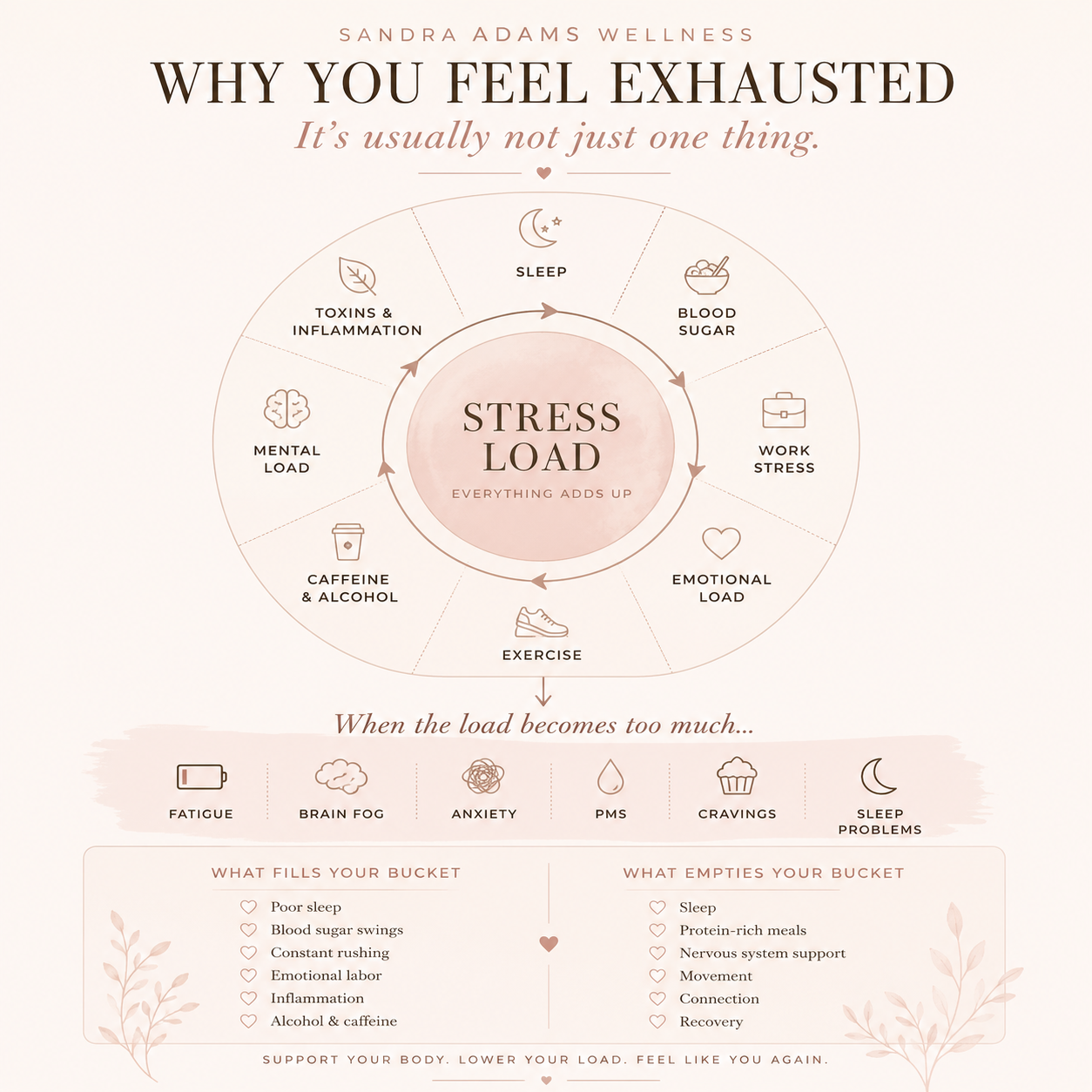
Most of the time it isn't one thing causing our symptoms. It's usually a collection of things that have been building over time. A poor night's sleep here, extra stress at work there, too much caffeine, not enough downtime, rushing from one thing to the next. None of them seem significant on their own, but eventually they start adding up.
I often think about stress like a bucket. Every day, little things get added to it. A poor night's sleep adds some. An argument with a family member adds some. Rushing through your morning adds some. Living on coffee and forgetting to eat lunch adds some. Even things we don't always think about, like inflammation, environmental toxins, mold exposure, or spending too much time scrolling social media, can add to the load.
None of these things are necessarily a problem on their own. The challenge is that most of us aren't dealing with just one thing. We're dealing with dozens of little stressors every single day, and eventually that bucket can start to overflow.
That is often when symptoms start showing up.
If you're wondering how many of these stressors might be affecting your hormones specifically, that's exactly what we look at together in coaching. Book a free discovery call here.
When Stress Becomes the New Normal
One thing I see often is that women have become disconnected from how stressed they actually are because stress has become normal. We are expected to work, manage households, care for children, maintain relationships, support aging parents, stay healthy, look good, and somehow do it all with a smile on our faces.
We have normalized stress to the point where many women don't even recognize it anymore.
One hidden stressor I think many women underestimate is rushing.
I know I have been guilty of this myself. Rushing out the door, rushing through meals, rushing to appointments, rushing through workouts, rushing through life.
When we are constantly rushing, we are constantly signaling to the body that there is something urgent happening. Over time, that can contribute to a nervous system that struggles to fully relax.
Small Changes That Make a Real Difference
The goal isn't to create a perfect life. The goal is to become aware of what might be filling your bucket and make small changes where you can.
Maybe that means prioritizing sleep. Maybe it means balancing blood sugar. Maybe it means cutting back on alcohol. Maybe it means spending less time scrolling. Maybe it means replacing one household product with a lower-toxin option when it runs out. Maybe it means simply slowing down enough to listen to what your body has been trying to tell you. These are exactly the foundations I build every coaching relationship around.
Stressing about all the stressors just creates more stress.
One of the biggest lessons I have learned is that the body is always communicating with us. If we are willing to listen, it often tells us exactly what it needs.
Supporting the body starts with awareness. Then it becomes about making sustainable changes that help us feel safe, supported, nourished, and regulated.
We can't control everything, but we can support our bodies in meaningful ways, and over time those small changes can add up to something powerful.
If there is one thing I hope you take away from this post, it is that stress doesn't have to take over your life. We can't avoid every stressor, but we can become aware of them, support our bodies through them, and stop letting our stress buckets overflow.
And that's a pretty powerful place to start.
If this resonated with you, you might also enjoy Why So Many Women Feel Wired But Exhausted — it goes deeper into the nervous system cycle that keeps so many women stuck. And if you're ready for personalized support, I'd love to connect.